


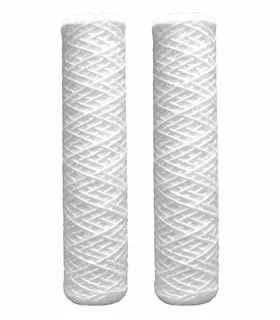
Wound Filter
A specific type of filter cartridge constructed by winding a continuous filament of material around a central core.
Key Features:
- Construction: Wound filters are created by winding a filament (often polypropylene or other synthetic fibers) around a central support core. This creates a dense, three-dimensional structure with varying pore sizes.
- Depth Filtration: These filters operate on the principle of depth filtration, where particles are trapped within the depths of the filter media.
- High Dirt Holding Capacity: Due to their structure, wound filters can capture a significant amount of suspended solids before requiring replacement.
- Relatively Low Pressure Drop: They generally exhibit lower pressure drop compared to some other filter types, allowing for more efficient water flow.
Applications in Water & Wastewater Treatment:
- Pre-filtration: Commonly used as pre-filters for more sensitive filtration systems like reverse osmosis (RO) membranes. They protect the membranes from damage by removing larger particles.
- Removal of Suspended Solids: Effective at removing suspended solids such as silt, sand, rust, and other particulates.
- Turbidity Reduction: Improve water clarity by removing particles that cause turbidity.
Benefits:
- High Dirt Holding Capacity: Can effectively remove large amounts of suspended solids.
- Relatively Low Pressure Drop: Minimizes energy consumption and maintains efficient water flow.
- Cost-Effective: Can be a cost-effective solution for many pre-filtration applications.
Wound filters are a valuable component in many water and wastewater treatment systems, contributing to improved water quality and protecting downstream equipment.


